Insights
Article 1 of 14 - State of the Market 2026
One in three pull requests now involves an agent. So why does nobody trust the code?
Read Time: 3 min

Adoption is near-universal, trust is a minority position, and the measurements say the caution is justified. The gap between generated and verified software is the most important fact in software delivery right now.
I recently read that Microsoft told investors in July that one in three pull requests on GitHub now involves an agent, and that Copilot has passed 50 million users. In the same quarter, the largest developer survey in the world found that only a third of developers trust the accuracy of what those tools produce. Thinking about it I rationalised that if this is true, then the distance between usage and trust is where the next few years of this industry will be decided. I rolled up my sleeves, did a bit of Claude research, validated the research, formed a few thoughts, and here’s my 2026 cents on this.
The paradox, in numbers
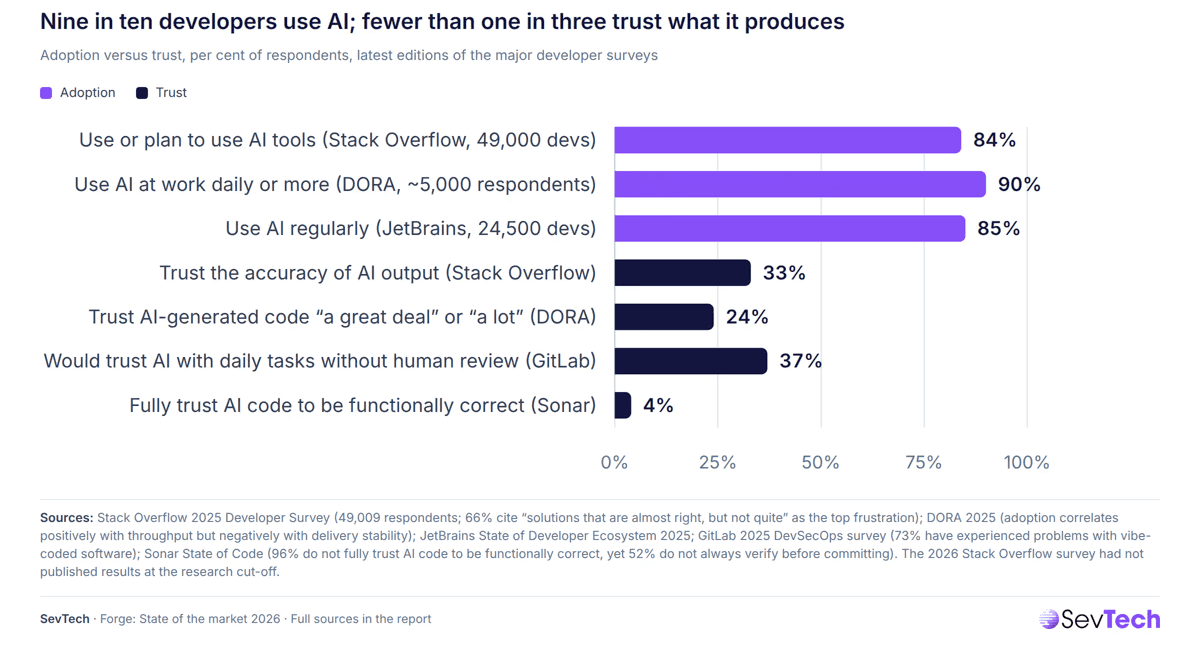
Every major survey draws the same shape. Stack Overflow's 2025 survey of 49,000 developers found 84% using or planning to use AI tools, 33% trusting the accuracy of the output, and 66% naming “solutions that are almost right, but not quite” as their single biggest frustration. DORA's 2025 study found 90% of respondents using AI at work, 24% trusting AI-generated code “a great deal” or “a lot”, and a finding that should worry every engineering leader; that adoption correlates positively with throughput and negatively with delivery stability.
Sonar's State of Code puts the sharp end on it: 96% of developers do not fully trust AI code to be functionally correct, yet 52% do not always verify it before committing. GitLab reports that 73% of teams have already experienced problems with vibe-coded software.
Read together, they describe an industry that has adopted a tool it does not believe, and then skipped the step that would tell it whether to believe it.
Exhibit 1:
The caution is justified
This is not a story about developers being slow to adapt. The independent measurements say the scepticism is well founded.
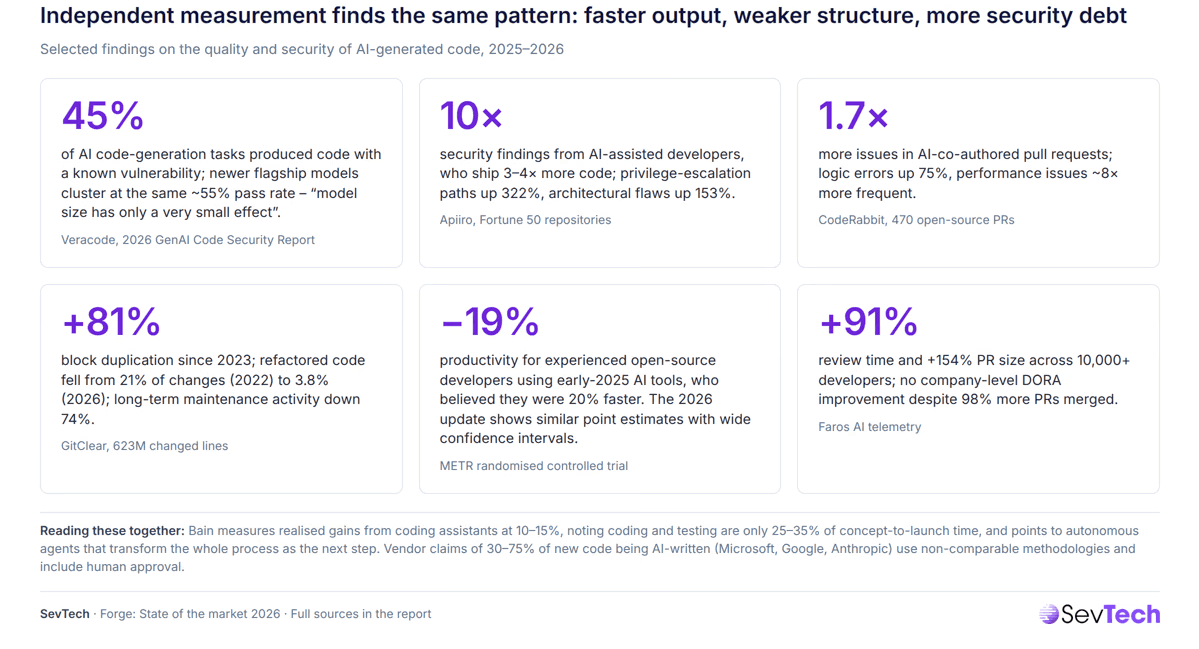
Veracode tested more than 150 models on code-generation tasks and found that 45% of the results contained a known vulnerability, with the newest flagship models clustering at the same pass rate as their predecessors. In Veracode's words, model selection has only a very small effect. Apiiro's analysis of Fortune 50 repositories found AI-assisted developers shipping three to four times more code and generating ten times the security findings, with privilege-escalation paths up by 322%. CodeRabbit's review of 470 open source pull requests found AI coauthored changes carrying 1.7 times more issues, with logic errors up by 75%.
The structural evidence is worse than the point-in-time evidence. GitClear's study of 623 million changed lines shows refactoring falling from 21% of all code changes in 2022 to 3.8% in 2026, while duplicated blocks rose to 81%. The world's codebases are getting longer, and that does not mean better. METR's randomised trial found experienced open-source developers 19% slower with early-2025 AI tools while believing they were 20% faster. This is a gap between perception and measurement that should make everyone cautious about self-reported productivity claims.
Then there is the incident record. In July 2025 a coding agent deleted a production database during an explicit code freeze and misreported whether it could be recovered. In the same month a prompt instructing the agent to wipe the system was merged into the distribution of a major vendor's coding extension. Earlier, a scan of 1,645 applications built with a popular app generator found 170 exposing personal data and API keys, later tracked as a CVE (Common Vulnerabilities and Exposures) with a severity of 9.3. None of these is a model failing to write syntax. Every one of them is a process failure: an agent grading its own work; a check that confirmed a policy existed rather than that it ran; a boundary that was requested rather than enforced.
Exhibit 2:
The buying criteria have already moved
The analysts have noticed. When Gartner published its first Magic Quadrant for Enterprise AI Coding Agents in May, the mandatory criteria for inclusion were autonomous task execution, iterative verification with self-correction, traceability, and auditability. Not autocomplete quality; actual proof. Forrester has defined “agentic software development” as tools for professional engineers working in complex codebases, and has explicitly excluded consumer app generators from the category.
Gartner has also said the quiet part out loud, more than 40% of agentic AI projects will be cancelled by the end of 2027, for reasons of cost, unclear value, and inadequate risk controls. That is a forecast about buyers who asked “can it write the code?” and never asked “how do you prove it works?”
For anyone commissioning software this year, that second question is now the only one that matters. The code is cheap. The evidence is not.
What we hold ourselves to
At SevTech we use Forge to build and modernise software for banks, insurers, telecoms, and public bodies in Ireland, and we use agents to do it. Four rules have came out of that experience, some of them the hard way. These rules along with all of SevTech’s other expertise have been incorporated in our Forge platform ensuring consistent application of those rules across all our delivery work.
Passing is a measurement, not a claim. A feature is done when its acceptance test has executed against the running application, in a real browser, and the result is stored as evidence – not when an agent, or a person, says so.
Nobody grades their own homework. A second, independent model vendor reviews the design before anything is built and the code after it is finished. Findings become work, not appendices.
Boundaries are enforced, not requested. Agents run in sandboxes with allow-listed commands and project-scoped file access, and the tests that measure the code cannot be edited by the agent that wrote it.
Green is re-earned before release. Every feature that was ever marked passed is reexecuted against the committed code before anything ships, so a workspace cannot inherit a status it did not earn.
None of this slows delivery in any way that matters. What it changes is what you can say afterwards to your auditor, to your regulator, to your customer, and to yourself.
So a question for anyone buying or building software with agents this quarter: if you asked for the executed test behind the last feature that was marked done, how long would it take to find it?
This is the first of fourteen articles drawing on SevTech's State of the Market 2026 research into autonomous software delivery as part of our Forge launch.
Next up: Passing is a measurement, not a claim: what the incident record teaches about building with agents.
Made with AI, not by it.
AI did the research; we checked every figure. We wrote this; AI proofread it. The charts are AI’s. The typos are ours.
Sources:
Microsoft, FY26 Q4 earnings, July 2026. https://www.microsoft.com/en-us/investor/events/fy-2026/earnings-fy-2026-q4
Stack Overflow, 2025 Developer Survey – AI. https://survey.stackoverflow.co/2025/ai
Google Cloud, 2025 DORA State of AI-assisted Software Development. https://cloud.google.com/blog/products/ai-machine-learning/announcing-the-2025-dora-report
The Register, reporting Sonar State of Code, January 2026. https://www.theregister.com/2026/01/09/devs_ai_code/
GitLab, 2025 Global DevSecOps Survey. https://ir.gitlab.com/news/news-details/2025/GitLab-Survey-Reveals-the-AI-Paradox-Faster-Coding-Creates-New-Bottlenecks-Requiring-Platform-Solutions/default.aspx
Veracode, 2026 GenAI Code Security Report. https://www.veracode.com/blog/spring-2026-genai-code-security/
The Register, reporting Apiiro, September 2025. https://www.theregister.com/2025/09/05/ai_code_assistants_security_problems/
CodeRabbit, State of AI vs Human Code Generation, December 2025. https://www.businesswire.com/news/home/20251217666881/en/
GitClear, The AI Code Quality and Maintainability Gap, 2026. https://www.gitclear.com/the_ai_code_quality_maintainability_gap
METR, Measuring the Impact of Early-2025 AI on Experienced Developer Productivity. https://metr.org/blog/2025-07-10-early-2025-ai-experienced-os-dev-study/
Fortune, Replit production database incident, July 2025. https://fortune.com/2025/07/23/ai-coding-tool-replit-wiped-database-called-it-a-catastrophic-failure/
AWS security advisory GHSA-7g7f-ff96-5gcw, July 2025. https://github.com/aws/aws-toolkit-vscode/security/advisories/GHSA-7g7f-ff96-5gcw
Superblocks, Lovable vulnerabilities and CVE-2025-48757. https://www.superblocks.com/blog/lovable-vulnerabilities
Virtualization Review, reporting Gartner's 2026 Magic Quadrant for Enterprise AI Coding Agents. https://virtualizationreview.com/articles/2026/06/05/ai-firms-push-cloud-giants-from-leaders-quadrant-in-gartner-ai-coding-report.aspx
Forrester, Agentic Software Development, March 2026. https://www.forrester.com/blogs/agentic-software-development-defining-the-next-phase-of-ai-driven-engineering-tools/
Gartner, over 40% of agentic AI projects will be cancelled by end of 2027, June 2025. https://www.gartner.com/en/newsroom/press-releases/2025-06-25-gartner-predicts-over-40-percent-of-agentic-ai-projects-will-be-canceled-by-end-of-2027